Variety Bill vs. Single-Format Show: What the Formats Ask of Performers
Variety bill vs. single-format show: see how each format shapes rehearsal, casting, and performance choices so you can recognize its demands onstage.
A variety bill asks performers to make a distinct act legible on its own; a single-format show asks them to serve a shared form or premise. That difference shapes what happens in rehearsal, from how an act is introduced to how performers coordinate with one another.
Neither format is inherently more demanding. A variety performer may need to establish a complete stage identity in a short turn, while a performer in a single-format production may need to sustain a character, style, or musical language across the evening.
A variety bill gives each act a separate frame
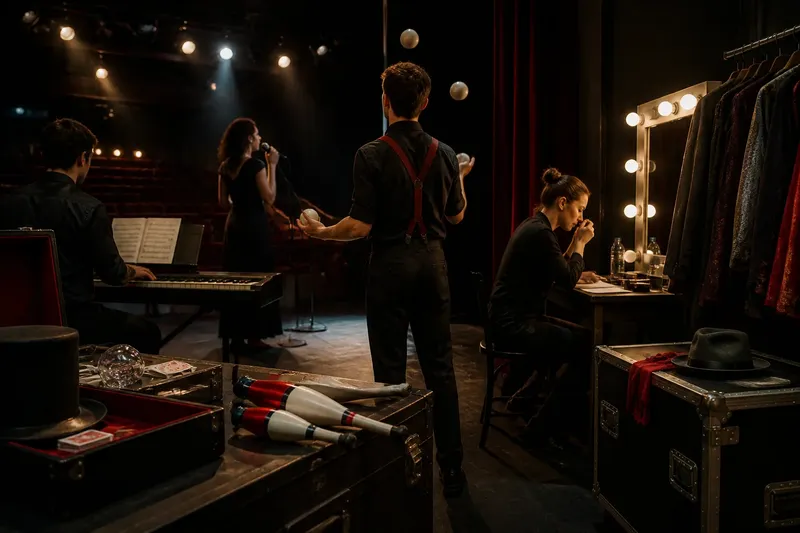
A variety bill might pair a stand-up comic, a juggler, a singer, and a magician. Each performer brings a separate technique and typically prepares a self-contained piece that can be understood without knowledge of the other acts.
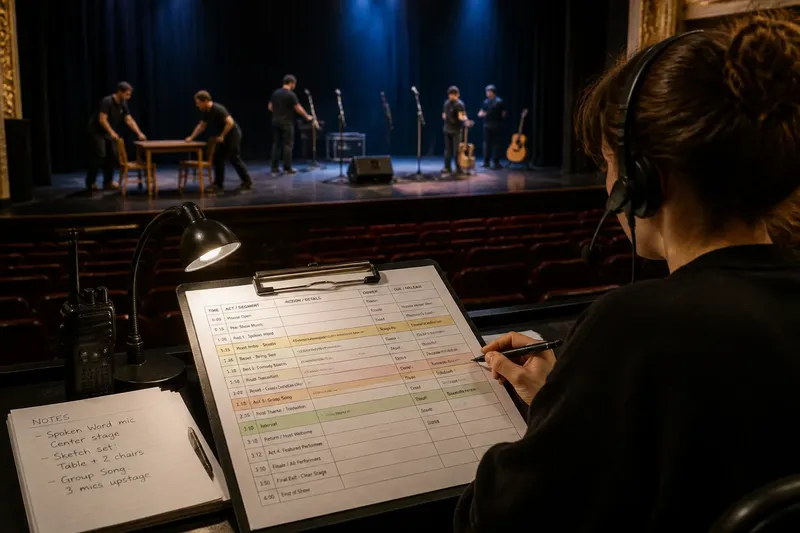
That independence affects practical choices. An act needs a clear opening, a workable ending, and a defined setup: a microphone and stool for a comic, for instance, or a table and suitable sightlines for close-up magic. The producer or stage manager must also establish how performers enter and leave and what equipment needs to be cleared.
For performers, the format can make a strong individual point of view especially useful. A comic may rely on timing and spoken language; a dancer may communicate through movement and music. The bill does not require those approaches to become one style.
A single-format show rewards shared technique
A single-format show centers on one recognizable kind of performance, such as a concert, a stand-up set, or a program of short plays. It can include many artists, but they work within expectations the audience can identify as part of the same form.
That shared frame gives performers room to develop technique across the production. In a concert, musicians can shape phrasing and dynamics within a common musical language. In a play, actors can respond to one another through a consistent script, character world, and approach to staging.
Rehearsal often involves coordination beyond each performer’s individual contribution. The cast and creative team may need agreement about style, timing, transitions, and how a recurring element changes as the show proceeds. A shared form is not automatic unity; it is a set of choices the company has to make together.
Rehearsal priorities differ by format
Variety acts often need to be tested as complete units: can the performer be heard, can the audience see the essential action, and can the act be set and cleared without disrupting the next one? The production team may schedule separate technical checks because a singer, aerialist, and storyteller can have very different needs.
For a single-format show, rehearsal may focus more heavily on relationships within the whole. A director might work with actors on how a scene changes the next one, or a music director might align an ensemble’s tempo and balance. Individual passages still matter, but they are judged partly by how they contribute to the production’s common approach.
Say a small theater is preparing a comic, a singer, and a storyteller, with a microphone, a keyboard, and a hand prop. If the theater presents three independent turns, it can assign each performer a self-contained setup and rehearse each changeover separately. If the same artists are building a musical-comedy revue around a recurring character, they need to rehearse not only their turns but also how the character and songs carry through the script; the added continuity can create coherence, while demanding more shared rehearsal.
Performers can tell which format fits a project?
Does a variety bill need a host?
No. A host can introduce performers and make the structure clear, but a printed program or direct staging can do that work instead. The choice depends on whether the production needs a person to connect the acts or simply present them.
Can one performer appear in several acts?
Yes. A performer can take on separate roles or contribute to multiple turns in a variety bill, provided each segment’s identity and setup remain clear. In a single-format show, repeated appearances more often serve a shared character, ensemble, or premise.
What should a performer ask before joining a bill?
Ask about the running order, available equipment, rehearsal and sound-check arrangements, and the expected length of the act. Those details clarify what the venue can support and what the performer must bring or adapt.
Can a production blend the formats?
Yes. A revue can present distinct acts while using a recurring host, character, or theme to bind them together. The company should decide whether performers are meant to present independent pieces, develop a shared premise, or do both.
Choose the format by the work it needs
A producer choosing between formats can start with the material rather than with a hierarchy of artistic value. If the pieces are strongest as independent encounters and require different skills, a variety bill can let each stand on its own. If their meaning depends on a common style, story, or ensemble, a single-format show may give that relationship room to develop.
For performers, the distinction offers a practical question: does this piece need to be complete by itself, or does it gain meaning from what the rest of the production establishes? The answer points toward the rehearsal, staging, and collaboration the work is likely to require.
The phrase “variety bill vs. single-format show” describes more than a difference in program design. It identifies two ways of organizing responsibility: each act can carry its own frame, or performers can build a frame together. That distinction helps a company make clear choices about preparation before the audience takes its seat.