How to Build a Run Sheet Around Clear Stage Transitions
A run sheet for live shows makes act order, stage changes, and pauses clear, helping the crew deliver transitions the audience can follow.
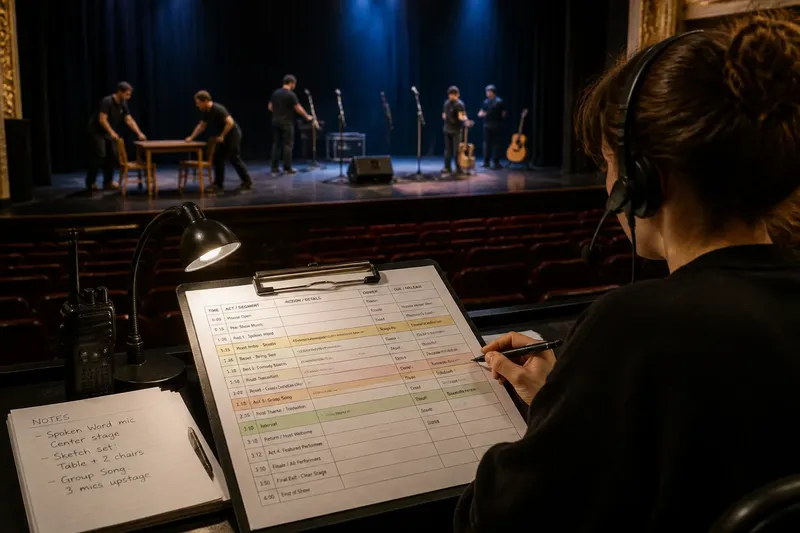
A run sheet for a live show needs to say what happens onstage between acts, not just when each act starts. If a piano has to leave before a spoken-word performer enters, the document should identify who moves it and what the host or crew does while the stage is being cleared.
That practical detail helps performers, hosts, and stage managers work from the same plan. It also makes it easier to spot a sequence that looks simple on paper but depends on an unclear cue or an awkward changeover.
Order acts around their setup and stage needs
Start by noting what each act needs before it can begin: microphones, instruments, props, furniture, lighting, or a particular entrance. Then consider whether the act can follow the previous one without a reset that disrupts the show.
A small acoustic act may need a quiet stage and a working microphone. A sketch using a table and several props may need space for crew to clear the previous setup. Treat those requirements as part of the running order, not as details to solve once the show is underway.
Imagine a theater bill with a spoken-word piece, a comedy sketch that uses a table and two chairs, and a group song requiring several microphones. The stage manager lists the spoken-word microphone first, then assigns the host to introduce the sketch while crew bring on the table and chairs. After the sketch, the host gives a brief transition while the chairs are cleared and the extra microphones are set; the resulting sequence gives each act a defined entrance and a known changeover.
Write each changeover as an actionable cue
A useful changeover entry identifies the action, the person responsible, and the signal that ends the transition. “Reset stage” leaves too much open; “Crew clears chairs on host’s final line; stage manager gives the next performer a stand-by cue” gives the team a sequence to follow.
Include what the audience will see or hear while equipment moves. A host introduction, a short musical cue, or a visible but intentional reset can work, provided it suits the event and the crew can deliver it. If no audience-facing bridge is needed, make that choice explicit so a pause is not mistaken for a missed cue.
Give pauses a clear purpose
Not every pause has the same job. A scripted silence belongs to the performance; a moment for applause to settle depends on the room; a stage reset requires time for crew to move equipment safely and prepare the next act.
Write the distinction into the run sheet. For applause-led transitions, give the host or stage manager a cue to proceed when the room is ready instead of assuming a fixed response. Mark a deliberate silence as part of the act so the crew does not treat it as a technical problem.
An interval also needs a clear return cue. State whether the host will invite people back, whether a sound cue will signal the next section, or whether the next performer begins after a stage-manager signal. That decision gives the front-of-house and stage teams a shared plan.
Check the run sheet before sharing it
Read the document from the first cue through the final exit, checking both the running order and the work each transition requires. For every item, identify an observable condition and decide what the team should do if that condition is not met.
- Check the opening act’s setup: If its microphone, props, and entrance are ready before the audience is seated, keep the opening cue; if not, assign a specific crew member to finish the setup before the host begins.
- Check each stage reset: If the next act can begin with the existing layout, leave it in place; if equipment must move, name who moves it and what cue or host line covers the change.
- Check microphone handoffs: If the same microphone works for both acts, keep the handoff simple; if the next act needs another microphone or stand, list who places it and when.
- Check prop ownership: If the incoming act brings its own props, confirm where they wait; if crew must supply them, assign a person to place and remove each item.
- Check response-based pauses: If the transition waits for applause or laughter, give the host or stage manager a proceed cue; if the silence is scripted, label it as part of the act.
- Check the interval return: If the audience returns to a ready stage, use the planned opening cue; if a reset remains, have the host hold the start until the stage manager confirms readiness.
- Check the closing sequence: If the final act has a clear exit and finish cue, retain the order; if the exit leaves equipment or performers in view, add a specific clearing action before the house lights or next announcement.
Which run-sheet details prevent confusion?
What should a stage reset entry include?
Name the equipment to move, the person responsible, and the cue that starts or finishes the work. Add the audience-facing bridge if the reset will be visible or requires a pause.
How should I show a flexible transition?
Separate cues that can be shortened, such as a host introduction, from actions that must happen before the next act can begin. State who decides to shorten the flexible part and what readiness signal releases the next cue.
How do I handle applause that varies?
Use a cue based on what the host or stage manager can observe, such as applause settling, rather than assigning an inflexible start moment. Keep the next action clear so the team knows what to do when the room is ready.
Make the document usable during the show
Use clear act names and put cue ownership beside each action. Distinguish planned start times from transitions that depend on applause, audience movement, or a stage-manager confirmation.
Keep essential instructions easy to scan: a host should not have to search through a paragraph to find the next line, and a crew member should not have to guess which piece of equipment to move. If the plan allows a transition to be shortened, state who may make that call and which parts must remain intact.
A run sheet for a live show is most useful when every stage change has an owner and a visible release cue. Read it once as the host and once as the stage manager; if either role has to infer who moves, speaks, or signals next, revise that entry before sharing the document.